I have written only one book review till now - when I was freelancing for CT Indian Life. I want to review two books on this blog post. You know, there are times when you read something, and know that this is going to always stay with you. These books are like that for me. They are both very well known. A lot of you would have already read them as they are not new. The first is the book 'A Mighty Heart' by Mariane Pearl and the other is 'The Last Lecture', written by the late Randy Pausch.
(Image courtesy: Amazon.com)
I read 'A Mighty Heart' maybe a fortnight back. After returning a string of books back to the library after reading only a page or two, I finished this book in about four days. I got this book when it was the 10th anniversary of the death of the American journalist Daniel Pearl, who worked with Wall Street Journal and was brutally killed in Pakistan. I wanted to read this book as I always wanted to know how he died, and the fierce way in which his wife fought to get her husband back. Why I loved this book is because of the sheer presence of mind that Pearl's wife Mariane had when everyone realized her husband was kidnapped. Despite being in the second trimester of her pregnancy, she and her fellow companion, Asra Nomani, took on the herculean task of trying to get him back. Although the outcome was known to me and any other reader, the book is still so gripping and poignant.
She does not give up till the very end. In a nation where she found it so hard to trust anyone, she had formed a trusted group of Pakistani and American men who were toiling day and night to get Daniel Pearl back. She was resilient, and coherent of whatever was going on around her. It was through his laptop and emails that they formed a map with Daniel in the center and all the members of the terrorist groups that he had interacted with. I learned from the book that you have to be calm when you are dealt with a challenge that you think is beyond your capacity to handle. She demonstrated that calmness. Mariane said that she had grown up chanting the Buddhist mantra - Nam Myoho Renge Kyo, which she chanted a lot when she and her late husband really needed. Imagine being pregnant and having to go through something of this magnitude that will change the course of your life.
Towards the end of the book, her description shows that she too, is human. She breaks down when a member of her trusted group gives the news of him being brutally killed. She finds some solace initially as her brother comes over to Pakistan. As promised, Mariane tells the story of herself and the group that had helped her immensely to several presidents - including the U.S. and French presidents. She also met with then President of Pakistan, Pervez Musharraf and has a no-nonsense talk with him. Apart from all this, she said something that I still think about. Mariane mentioned that she has not lost her spirit to live and not lost her purpose in life. She said that if she loses that, then she will give in to what the terrorists always wanted and she will not give them that. She is now mother to an almost ten-year old son.
I read The Last Lecture almost six months ago when I had just moved to Washington DC, and had time on hand (and no TV to distract me). A lot of people had told me about this book, or at least see the lecture on line. I am quite certain most of you know about the author. If you don't, he was a professor at Carnegie Mellon University and was diagnosed with pancreatic cancer and had very few months to live. The University regularly conducts these hour-long sessions, where professors are invited to talk that if you had to give one last lecture, what would you say. Ironically, Pausch didn't work at the University much longer after this lecture. The reason behind reviewing this book is that he had some very simple lessons to offer. The lecture or the book is not a self-help book. But it does make you think, and in my case, it did make me implement what I learned through his book.(Picture courtesy: Amazon.com)
Pausch's kids are very young and he wrote the book and steered the lecture in a way that his children would know about him, even when he is not there. He passed away in 2008. In his lecture, he talks about how to achieve your childhood dreams. There are a few things that just stayed with me. For instance, his very famous quote is that brick walls are there for a reason. He said that brick walls/ obstructions are for those people who don't want something so badly. If you really want something, you will not let the brick wall deter you. He gave an example, by which he said that when you want something, keep trying. And when those who are trying to stop you for whatever reason stop that, at that time you know that you will make it. A and I knew this was true soon after we read the book. A's interview process for his current job in DC took a very long time, and we kept getting mixed signals. But he was persistent, and he didn't let anything deter him.
The other thing that Pausch said, which I know, a lot of us can use is to never give up. He mentioned that every person has a good side to himself. And you have to wait a long time for a person to show his/ her good side. Simple lesson, but very profound. How often have we given up on someone, because that person has done a lot of bad in our lives, and to those we love. One has to wait and that person will show his/her good side at one point.
Of the several other profound thoughts that he had, he cited an anecdote, where his colleague gave him advice on relationships. He said that when it comes to men, who are romantically interested in a woman, ignore everything they say. Just pay attention to what they do. It is profound advice that a lot of us can implement or share with soon-to-be adolescent children.
In short, I loved his book as it shows his and his wife's resilience amidst an illness that he eventually succumbed to. And that is was positive from any angle you looked at. The girl part of me loved his admiration for his wife and the beautiful way he thought of her and got her a cake during his last lecture. It was very emotional and if you read the book, you will read what their interaction was during that special moment. Read this book to believe in yourself, to start something new, to love your significant other and children and never take anything for granted. Cancer is a disease that takes a lot of you and your family. Only those who have lived through it or have seen their family member through it, would comprehend the tireless and unending efforts one makes.
The common theme between both these books is the extremely brave women - the better halves of both the men who are not in this world anymore, but am sure are there in spirit with these women. We all can learn a thing or two from their courage.
This post is dedicated to a very close family member who passed away last week, after battling cancer.
Wednesday, February 29, 2012
Monday, February 20, 2012
Worried about daily meals? Kickstart your Week with a Food menu-list
I was speaking to my masi (mother's sister) in Bombay the other day, and told her that once I have the menu ready for the week, things are a breeze. And she said that it is a good idea to have a menu ready, so in the middle of the week, you don't feel like, 'Oh I don't want to eat this today.' Or your wife or mother will not bore you with the same question, 'What should I make for dinner tonight?'
What had started as a compulsion for me has now become a habit. When I was in school for two years, and also worked, there used to be nights when A and I returned home by 8:30 - 9 PM. The last thing you want to do then is stand over a stove and cook potatoes or make a healthy pasta. So we began making a menu every weekend. A lot of things become easy if you plan your menu for the week on a Friday or Saturday. For starters - your trip to the grocery store becomes much more beneficial. You know what you want, how much and why you want it. As a family member pointed out, since things are planned out, you don't visit the grocery store on a weekday, running to buy single things like onions or a bunch of cilantro (fresh green coriander). Since you are putting ten minutes aside only to make a list, you make sure that a) You make healthy things that are a good balance of proteins and starch and carbs and b) You don't have to eat the same boring roti-sabji (Indian flat bread with dry veggies or veggies with curry) everyday. You can put a good casserole for one day, healthy soup the other and roti-sabji the third. There - we just planned a three-day meal for you in less than five minutes. Also, if you are a picky person - you have a say from the start in what you want to eat. If you say at the last minute that you want to eat something interesting and nice, chances are the ingredients may not be at home. In this case, it won't be so.
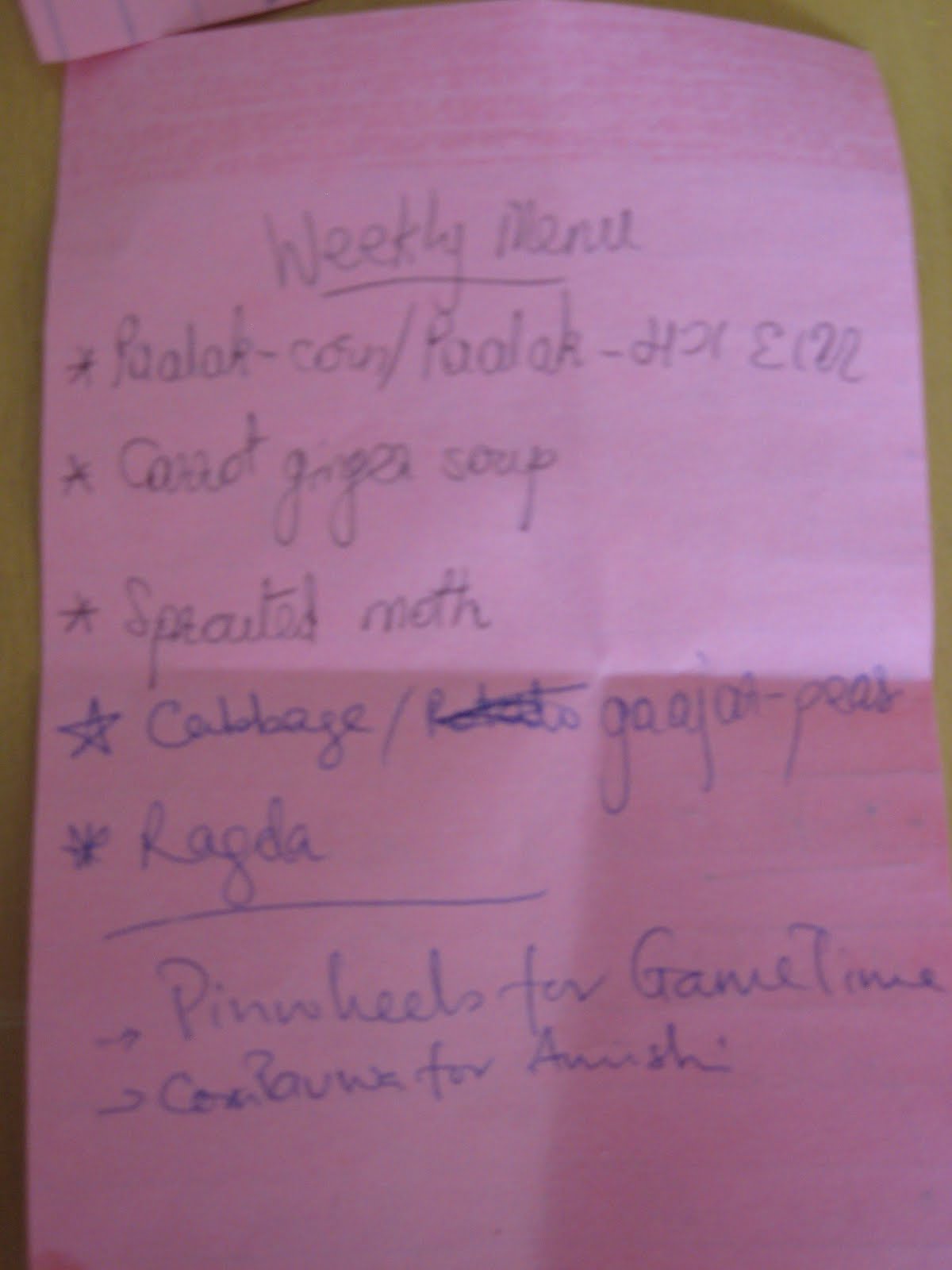
It has been a long time now since we have been making menus and putting it up on the fridge. I would like to share some tips that may make your task a little bit easy. I have shared my own lists with you in these photographs. As you see in one picture, you can even combine a to-do-list with it.
1. If there are things in your fridge waiting to be used, see what you can cook with those. It's amazing you can make a good square meal out of humble leftovers, or uncooked vegetables or meat if you have that in your fridge.
2. If you have been really keen to try a new recipe, put that on your list. Encourage your creativity.
3. Make it a point to write your list before you do your weekly grocery. Write all ingredients you need that you don't have at home, especially if it is a new recipe.
4. Very important - don't forget to take the list to the store. Sounds crazy, but don't tell me you have never left your list at home and realized it the minute you enter your superstore.
5. As you make the list, go over in your mind whether you'd like to take leftovers for lunch the next day. If not, please add lettuce, cucumber and basic salad needs to take salad to work.
6. Make your list healthy - make sure to put ample legumes and sprouts and greens to your menu. If you eat any kind of meat, space it out for the five days and include that as well.
7. Last, but very important - don't make your menu boring. If it is, then it is very likely that you'll be tempted to order take-out Chinese food on Wednesday night!
I now come home and make my meal every night. But as a student, I cooked on Sundays for the week. It's your call. If you want, you can also chop veggies on Saturday or Sunday and refrigerate them. It will be so simple to just saute them after that. Depending on your schedule - you can cook daily or every two days or over the weekend if you want.
If you cook at home, and try to eat an overall healthy-balanced meal, please give this a shot. Give ten minutes of your time to a small list and see the difference it makes. It will give you peace of mind and an opportunity to include favorites of what every member in your family wants to eat.
Go ahead, give it a try. And let me know how it works for you.
What had started as a compulsion for me has now become a habit. When I was in school for two years, and also worked, there used to be nights when A and I returned home by 8:30 - 9 PM. The last thing you want to do then is stand over a stove and cook potatoes or make a healthy pasta. So we began making a menu every weekend. A lot of things become easy if you plan your menu for the week on a Friday or Saturday. For starters - your trip to the grocery store becomes much more beneficial. You know what you want, how much and why you want it. As a family member pointed out, since things are planned out, you don't visit the grocery store on a weekday, running to buy single things like onions or a bunch of cilantro (fresh green coriander). Since you are putting ten minutes aside only to make a list, you make sure that a) You make healthy things that are a good balance of proteins and starch and carbs and b) You don't have to eat the same boring roti-sabji (Indian flat bread with dry veggies or veggies with curry) everyday. You can put a good casserole for one day, healthy soup the other and roti-sabji the third. There - we just planned a three-day meal for you in less than five minutes. Also, if you are a picky person - you have a say from the start in what you want to eat. If you say at the last minute that you want to eat something interesting and nice, chances are the ingredients may not be at home. In this case, it won't be so.
It has been a long time now since we have been making menus and putting it up on the fridge. I would like to share some tips that may make your task a little bit easy. I have shared my own lists with you in these photographs. As you see in one picture, you can even combine a to-do-list with it.
1. If there are things in your fridge waiting to be used, see what you can cook with those. It's amazing you can make a good square meal out of humble leftovers, or uncooked vegetables or meat if you have that in your fridge.
2. If you have been really keen to try a new recipe, put that on your list. Encourage your creativity.
3. Make it a point to write your list before you do your weekly grocery. Write all ingredients you need that you don't have at home, especially if it is a new recipe.
4. Very important - don't forget to take the list to the store. Sounds crazy, but don't tell me you have never left your list at home and realized it the minute you enter your superstore.
5. As you make the list, go over in your mind whether you'd like to take leftovers for lunch the next day. If not, please add lettuce, cucumber and basic salad needs to take salad to work.
6. Make your list healthy - make sure to put ample legumes and sprouts and greens to your menu. If you eat any kind of meat, space it out for the five days and include that as well.
7. Last, but very important - don't make your menu boring. If it is, then it is very likely that you'll be tempted to order take-out Chinese food on Wednesday night!
I now come home and make my meal every night. But as a student, I cooked on Sundays for the week. It's your call. If you want, you can also chop veggies on Saturday or Sunday and refrigerate them. It will be so simple to just saute them after that. Depending on your schedule - you can cook daily or every two days or over the weekend if you want.
If you cook at home, and try to eat an overall healthy-balanced meal, please give this a shot. Give ten minutes of your time to a small list and see the difference it makes. It will give you peace of mind and an opportunity to include favorites of what every member in your family wants to eat.
Go ahead, give it a try. And let me know how it works for you.
Thursday, February 16, 2012
New Delhi and Washington DC - my Perceptions
My cousin M introduced me to a friend of hers, who lives close to where I do in the District. During the course of conversation over dinner, our talk veered on how Delhi is as a city. Delhi is the capital of India and is situated in the northern part of the country. One of M's friends had told her that she would be careful in a city like Delhi (or something to that effect. I forget what she said exactly). I echoed her thoughts. When I worked in Bombay (yes, I still call it Bombay, rather than Mumbai), the head office was in Gurgaon, and so I went to Delhi a few times and have also been to Delhi during family trips.
There is something about Delhi that would naturally make me more guarded. I never for a minute felt that I was not originally from Bombay during the more than three years that I lived there, but Delhi definitely made me feel like that. Like me, most people in Bombay would walk around freely, not explicitly thinking of their safety. Being a woman, and not from Delhi, I used to be careful every time I was there.
What I noticed in Delhi was that everyone knows a politician or someone in the political circle. The minute you are about to enter in an argument or squabble with a person, the first thing that the person may tell you is, "You probably don't want to mess with me as my connections go a long way and I know politician X and Y from A or B party political party." I used to feel like I was one of those people who didn't know any politician, and was all by myself.
This is entirely my perception - but I feel like people from Delhi can outwardly be very sweet to you, but I would be wary of their intentions and how they would react to a situation. If you asked a simple question, you might just be countered with several other questions - asking your intent of that question and a simple situation could just get convoluted in no time. To tell it simply, the straightforwardness seemed amiss from the people. The other thing was that if you traveled by auto rickshaw drivers in Delhi, you would have to haggle for the travel fare. I saw this when I went in 2009. My friend T had told me about it, so I was aware of it. It is not as if the rickshaws are devoid of meters. They do have meters, but they just don't use them. Thankfully I didn't let the driver get the better of me. Whereas in Bombay, you pay the auto rickshaw driver by the meter.
That's why, when I decided to make the move to Washington DC, which is the capital of the United States, this thought that, 'What if DC is like Delhi?' kept coming in my mind. And I wanted to live in a Bombay-like city. Before coming here, I used to wonder if here too people would be more than eager to associate themselves with a politician (even if s/he is a wannabe), and I had to be guarded 24X7. Thankfully, in the first month itself, my thoughts were put to rest. I have felt safe on the Metro and when I come home after it gets dark (Irritatingly enough, it used to get dark by 5 PM till about two weeks back!) I have had a smooth transition from the mid-west to DC and am enjoying work and what this city has to offer.
Please note that what I write on this blog are entirely my opinions.
There is something about Delhi that would naturally make me more guarded. I never for a minute felt that I was not originally from Bombay during the more than three years that I lived there, but Delhi definitely made me feel like that. Like me, most people in Bombay would walk around freely, not explicitly thinking of their safety. Being a woman, and not from Delhi, I used to be careful every time I was there.
What I noticed in Delhi was that everyone knows a politician or someone in the political circle. The minute you are about to enter in an argument or squabble with a person, the first thing that the person may tell you is, "You probably don't want to mess with me as my connections go a long way and I know politician X and Y from A or B party political party." I used to feel like I was one of those people who didn't know any politician, and was all by myself.
This is entirely my perception - but I feel like people from Delhi can outwardly be very sweet to you, but I would be wary of their intentions and how they would react to a situation. If you asked a simple question, you might just be countered with several other questions - asking your intent of that question and a simple situation could just get convoluted in no time. To tell it simply, the straightforwardness seemed amiss from the people. The other thing was that if you traveled by auto rickshaw drivers in Delhi, you would have to haggle for the travel fare. I saw this when I went in 2009. My friend T had told me about it, so I was aware of it. It is not as if the rickshaws are devoid of meters. They do have meters, but they just don't use them. Thankfully I didn't let the driver get the better of me. Whereas in Bombay, you pay the auto rickshaw driver by the meter.
That's why, when I decided to make the move to Washington DC, which is the capital of the United States, this thought that, 'What if DC is like Delhi?' kept coming in my mind. And I wanted to live in a Bombay-like city. Before coming here, I used to wonder if here too people would be more than eager to associate themselves with a politician (even if s/he is a wannabe), and I had to be guarded 24X7. Thankfully, in the first month itself, my thoughts were put to rest. I have felt safe on the Metro and when I come home after it gets dark (Irritatingly enough, it used to get dark by 5 PM till about two weeks back!) I have had a smooth transition from the mid-west to DC and am enjoying work and what this city has to offer.
Please note that what I write on this blog are entirely my opinions.
Friday, February 10, 2012
Bidding Adieu
I don't want you to be misled by this title. I am not going anywhere and nor are we moving. This title is about what we (A and I) went through a couple of months back. I said bye to Columbus, Ohio first in August, and finally in December, 2011. A bid his farewell to the city, close to New Years Eve. When I flew out of Columbus the last time, I was reflecting on how saying bye feels and the various times we have done this. All of us have gone through this similar phase - at some point or the other.
I remember three distinct farewells now. One was when I left India in 2006 to come here, the other when A and I left Connecticut to move to Columbus and now when left Columbus to settle in Washington, DC. If there is one common thread between the three, then it is that that your association with a place lasts longer than you think. When I was leaving Bombay, my friend K told me not to be sad that I was going away. She said that we will continue to be in touch. And we are. After six years, I find myself connecting with K often, or speaking to her when I am super elated or confused or….
Your ties with a place are not simply restricted till the time you live there. What I learned - you will keep in touch with the people you want to. You will miss them, yes, but, if you really want to, you will maintain contact. And that's the good thing. This is not because we have Facebook, which has made things easier. You will be in touch via other ways also. I had emailed someone from my work place in Columbus last week. And she said, I am doing a good job of keeping in touch. I feel as if some things don’t require a lot of time and effort. I have seen some of the busiest people reply every so quickly to emails. There is always time to send a two-sentence email to people who you think about.
You may move on from one place. But memories from there remain. A and I still miss a lot of things about Connecticut. Most of all, we miss the people and our friends. Other than that, we miss the parks and other things we take for granted. There used to be an Asian restaurant that we really liked. It still lingers on in our minds. The first time we went back to Connecticut, A and I wanted to go to all our favorite restaurants and visit some parks that we really liked.
We all get emotionally attached and associate one place with a particular event, which makes it more special. For instance, it was Connecticut where I first landed after we were married and I first came to this country. Although I didn't have much of an adjustment period, everything that I knew about the United States was first through New Britain, Connecticut. It is the place from where A got his PhD. Bombay was where I began working, and made some really close friends. Columbus, Ohio is where I went to school. That too, was huge for me, considering several things. So you may bid adieu to a place, but the emotions and sentiments remain.
It is for the same reason that after all these years, we hear our parents recount that, "When we lived in Nairobi or when we lived in Calcutta, we went for a safari every Sunday or peanuts cost X rupees." They talk ever so fondly about their time there, the weather and how the place was. Who knows, someday, after twenty years, we will recount to our children or friends of how life was when we were in our 20s and 30s.
Wednesday, January 25, 2012
The Wonder Years - Through Our Nieces
Today's blog is about our (A and me) five nieces. Their age range is from six months to twelve years (6 months, 4 years, 8, 9 and 12 years). The reason why I write this post is because we get to see a whole spectrum of growth as we look at all five of them and different stages of development - their current interests, how they change with time, what they learn, etc. What each of them individually goes through at their respective age and how the transition happens to an older age is amazing. I don't want to name names, so for the sake of simplicity, the oldest (12-year old) is called A, 9-year old is B, 8-year old is C, 4-year old is D and the youngest is E. This blog is not about how each one of them is (her personality, individuality, etc). It is about the different stages of their childhood and pre-adolescence.
I have seen D and E (the younger two ones) since the time they were born. And have seen A, B and C since they were two, three and six years old. We now talk to the oldest one as an adult. She is a tween. If you were to chat with her, you would not realize that she is a tween. The only thing that gives it away is her extensive use of emoticons and smiley faces. When B and C were three and four years old, we used to spell out words, so they would not understand it. Now we do that for D. D was super excited that it was her birthday near Christmas. She was looking forward to having a princess-themed cake and candles for her big day. Yes, like other girls her age, she loves princesses and was a princess on Halloween. The older nieces went through that phase also, and have since, moved to dressing up as other characters for Halloween (read as scary witch, bed head, etc). The youngest one was too little to have a Halloween costume, so she will wait one more year for her own costume. At the end of the day, irrespective of the age they are, they all enjoy their candies and chocolates!
When we see E, the youngest one, A (the husband and not the niece!) and I are reminded of our nieces when we saw them when they were so young. E's latest thing is that she has just begun to turn on her own. I remember D began rolling from her bed the first time when we got her to Connecticut in 2008. My sister and I were in the kitchen and when we came out, she had rolled out of her little make-shift bed. E will give you the best smiles when you spend time with her.
It is so interesting to see how each has their own personality and how that plays in with their age. A and her sister C, are four years apart. Till about a year and a half back, they played with their common friends and A would play the same games as C. We are now seeing that she has grown out of that, and spends time with her friends during parties. And C plays with her own friends. With becoming a tween, also comes the thing of sleep overs. Being the oldest, she was the first to be invited to sleep overs at her friends' place as well as host sleep overs at her place. If she has moved on to sleep overs, D is still at the play-date age. She loves to go her best friend's place and play anything from lego to playing with excavator trucks to their parents reading them books.
B and C are only a year apart from each other. When we did the family trip to Canada during last summer, it was very interesting to watch both of them. The cousins were meeting after a long time. So when they first met, B and C were walking on the road, hand-in-hand. They talked non-stop and had much to share. There were a few times I think when all three were in the same car. I can only imagine what the adults in the car must have gone through! We no longer can distract them and make them silent by saying, "Count the number of red cars that pass by" or saying "Let's play the game of who stays quiet for longer". While that trick still applies to D. She remembers that and a day or two after we have left her place, she will tell her mom that she spotted a red car! I am sure within a year or two, she too will outgrow that. A (the hubby) used to spell things out when his nieces were younger. Like spelling out I-C-E C-R-E-A-M, so they would not understand it. We now do it with D. B was a terrific host when we went to Canada. Although she is nine, she made sure that all of us were comfortable and was a great guide at Calgary's stampede.
You must have already noticed that we do get to see a wide spectrum of interesting aspects with the girls and how different they all are. D's best friend is a boy and to her, he is just like her. B and C believe that boys are bad, and they are their enemies. While A is beginning to understand a little more than that. When we see all of them, we sometimes do wonder how each of them will be when they grow up. From all five of them, E has the best life as of now. She eats and sleeps. The oldest one is entering the phase where school work has just begun to get important, along with following other activities. B loves to ice-skate, C enjoys swimming and tennis, and D had her first swimming lessons this past summer.
They are not different in everything. We do see some similarities. All four girls love to dress up and they all love make-up. They wait for an occasion when mommy will allow them to apply some make-up. Another thing - they all love celebrating their birthdays. If one had a princess-theme, another was all too happy to spend her birthday with the entire family. She told her classmates about it excitedly. The others like it at a gaming plaza or having friends over for a sleep over. A (the hubby) and I can't help, but remark at times, that we get to see such different stages of growth in all five of them. We feel lucky for that and to a very large extent - it is a big learning experience for us. If you have stories about your nephews and nieces, do share them. I would love to know about them.
I have seen D and E (the younger two ones) since the time they were born. And have seen A, B and C since they were two, three and six years old. We now talk to the oldest one as an adult. She is a tween. If you were to chat with her, you would not realize that she is a tween. The only thing that gives it away is her extensive use of emoticons and smiley faces. When B and C were three and four years old, we used to spell out words, so they would not understand it. Now we do that for D. D was super excited that it was her birthday near Christmas. She was looking forward to having a princess-themed cake and candles for her big day. Yes, like other girls her age, she loves princesses and was a princess on Halloween. The older nieces went through that phase also, and have since, moved to dressing up as other characters for Halloween (read as scary witch, bed head, etc). The youngest one was too little to have a Halloween costume, so she will wait one more year for her own costume. At the end of the day, irrespective of the age they are, they all enjoy their candies and chocolates!
When we see E, the youngest one, A (the husband and not the niece!) and I are reminded of our nieces when we saw them when they were so young. E's latest thing is that she has just begun to turn on her own. I remember D began rolling from her bed the first time when we got her to Connecticut in 2008. My sister and I were in the kitchen and when we came out, she had rolled out of her little make-shift bed. E will give you the best smiles when you spend time with her.
It is so interesting to see how each has their own personality and how that plays in with their age. A and her sister C, are four years apart. Till about a year and a half back, they played with their common friends and A would play the same games as C. We are now seeing that she has grown out of that, and spends time with her friends during parties. And C plays with her own friends. With becoming a tween, also comes the thing of sleep overs. Being the oldest, she was the first to be invited to sleep overs at her friends' place as well as host sleep overs at her place. If she has moved on to sleep overs, D is still at the play-date age. She loves to go her best friend's place and play anything from lego to playing with excavator trucks to their parents reading them books.
B and C are only a year apart from each other. When we did the family trip to Canada during last summer, it was very interesting to watch both of them. The cousins were meeting after a long time. So when they first met, B and C were walking on the road, hand-in-hand. They talked non-stop and had much to share. There were a few times I think when all three were in the same car. I can only imagine what the adults in the car must have gone through! We no longer can distract them and make them silent by saying, "Count the number of red cars that pass by" or saying "Let's play the game of who stays quiet for longer". While that trick still applies to D. She remembers that and a day or two after we have left her place, she will tell her mom that she spotted a red car! I am sure within a year or two, she too will outgrow that. A (the hubby) used to spell things out when his nieces were younger. Like spelling out I-C-E C-R-E-A-M, so they would not understand it. We now do it with D. B was a terrific host when we went to Canada. Although she is nine, she made sure that all of us were comfortable and was a great guide at Calgary's stampede.
You must have already noticed that we do get to see a wide spectrum of interesting aspects with the girls and how different they all are. D's best friend is a boy and to her, he is just like her. B and C believe that boys are bad, and they are their enemies. While A is beginning to understand a little more than that. When we see all of them, we sometimes do wonder how each of them will be when they grow up. From all five of them, E has the best life as of now. She eats and sleeps. The oldest one is entering the phase where school work has just begun to get important, along with following other activities. B loves to ice-skate, C enjoys swimming and tennis, and D had her first swimming lessons this past summer.
They are not different in everything. We do see some similarities. All four girls love to dress up and they all love make-up. They wait for an occasion when mommy will allow them to apply some make-up. Another thing - they all love celebrating their birthdays. If one had a princess-theme, another was all too happy to spend her birthday with the entire family. She told her classmates about it excitedly. The others like it at a gaming plaza or having friends over for a sleep over. A (the hubby) and I can't help, but remark at times, that we get to see such different stages of growth in all five of them. We feel lucky for that and to a very large extent - it is a big learning experience for us. If you have stories about your nephews and nieces, do share them. I would love to know about them.
Saturday, January 21, 2012
Pictures from the Newseum
Cameras used by photojournalists - Then and Now
Part of the Berlin Wall. This was seen as a time when there was lack of communication between people.
Advent of New media
9/11 Newspaper Front Pages
Saving the best for the last - the view from the terrace
Part of the Berlin Wall. This was seen as a time when there was lack of communication between people.
Advent of New media
9/11 Newspaper Front Pages
Saving the best for the last - the view from the terrace
Visit to the Newseum
As I write this title, I feel like a child in 4th grade/ standard, who has been told to write about her visit to the zoo! I am not in 4th grade, and I did not go to the zoo either, but I sure was as excited as a ten-year old to go to the Newseum. One – the Newseum, as the name suggests, is a museum for news (read as media). That being my former profession, it definitely interested me. Two – there are some great exhibits there, which I will talk about in this post. Three – I had awesome company in A
I had already been to the Newseum in September with my friends, N and H from Columbus, Ohio. They too, live in the greater DC area. I will start with two of my favorite exhibits over there. One was that of Pulitzer prize winning photographs. There were breathtaking photographs, most of which made you think for a few minutes before you moved to the next. There was a beautiful picture of a family being reunited after the Second World War. The expressions are that of relief, joy and so much more. There were pictures of the fire that took place in Chicago so many years back, and all the destruction that took place. There was one picture, where only a woman’s hand was shown. Her fore arm was infected, and she was shown holding a household blade. It was a picture depicting female circumcision in Kenya. It is alarming that that despite awareness being raised about it, that painful tradition still is a part of some African countries.
A gripping picture was that of a famine in Africa, taken in the early 1990s. There was a small child (less than two years), clearly malnourished, in a very dry place. And behind her was a vulture, waiting to make the child its meal. The photographer managed to get rid of the vulture, and made the girl safe temporarily. He received a lot of negative comments when the picture was released, as to why he never saved the girl. And he was noted telling a friend that he had felt very bad about not helping the girl. After a few months, he committed suicide. There was a 10-15 minute video presentation that kept running, where Pulitzer prize winning photographers talked about their tasks. There were some that stuck with me. One said that you don’t do your job thinking that today I am going to click a Pulitzer Prize winner. It just happens. You can’t plan for it. Another lady said that she had seen so much pain and suffering in adults and in a lot of children, that in order to deal with it, she took pictures of people helping other people. And how she could show compassion through her photographs.
This was one of the sections that I really liked. The other was a sub-section of a bigger section. The bigger section was that of the Federal Bureau of Investigation (FBI). It had various exhibits within it, giving a good historical aspect also. One of my favorites was that of Sept 11, 2001. It had collections ranging from the plane’s parts to what was found in it, to confiscated passports of the terrorists in the planes. One of the most striking things there was the original letter that was given to each of the terrorists, which they were to read the night before Sept 11. It was not written in English, but a translated sheet was kept next to it. The letter stated the justification given to them, as to why they were doing this, and the supposed thing that it was the right thing to do. When I read the letter the first time, I re-read it. And yet I took time to digest it. When I went with A this time round, I told him to read it. He too was in disbelief.
Moving on from this emotionally-charged exhibit to a lighter one, there was a temporary/ traveling exhibit on sports photography. Several photographs were from the magazine, Sports Illustrated by Nick Leifer. There were pictures that showed the intensity of former tennis players, Martina Navratilova and Chris Evert. The photographer mentioned that Mohammed Ali was a delight to photograph, and had a wonderful personality.
One of the other really nice permanent exhibits is the evolution of media from radio to television to the Internet. It was historically rich, and wonderfully captured key moments in history and how media was used to broadcast that news. For instance, they showed the assassination of President John F. Kennedy and how people got information at every step of the way. The other one, where millions of viewers turned on their TV sets was the wedding of the beautiful Lady Diana and Prince Charles. I wish that along with the wedding of lady Di, they kept a big poster of the big 2011 wedding of Prince William and Katherine.
That would have plastered a smile on my face for the rest of the day. The historical perspective continued with key political moves, natural disasters and other important events. A small room was also dedicated to social media, and how it was used in the revolution in Egypt. A humorous angle to social media was how Twitter would have been used if it was around during the time of the Civil war. It was quite funny to read that. The other humorous part in the Newseum was continuous clips being shown about late night TV shows. This included shows of Stephen Colbert, Jay Leno, David Letterman, Jimmy Fallon, Jon Stewart, Saturday Night Live and others. They have played a key role in media and portraying the truth behind key developments in a humorous and satirical manner. A and I, along with other visitors had a nice time laughing at these clips, especially after watching some intense displays.
On the same floor as the late night shows and development of media, was one more intense display. It was that of September 11, 2001. This was different from the one of the FBI. This gave the journalists' perspective. The center piece was the destroyed top of one of the towers of the World Trade Center buildings. On one of the walls were front pages of national and international newspapers on the day after this horrific incident. I was at the Newseum the first time on September 10, 2011. Several people choked up and some were crying as they went through this exhibit. A video clip that was being played showed raw footage, interviews with people who saw it up and close and the destruction that took place.
On the other side of the center piece were remains of the only journalist, a photo journalist, who died while covering what was happening on that sunny morning in September. His was a moving story of how he and his wife were walking their dogs when they heard about it. He rushed home to get his cameras, and never came back. They retrieved his cameras, which revealed some of his best shots. But he didn't live to see them. It was touching to see his glasses, phone and other personal belongings on display.
------
Journalists that made an impact
There was one exhibit on Katrina that was there when I went in September. Without going in the details, there was a clip of Anderson Cooper of CNN where he was livid about politicians making tall claims and doing nothing while people died and suffered in the aftermath of the disaster. And there was another clip of Brian Williams of CNBC being angry about the same thing. I had this thought then that it would be terrific if both these men featured in the same show. They would make a great team. Here is a collection of headlines after Hurricane Katrina struck New Orleans.
The other one was the exhibit on Tim Russert. He was the long time face of the show 'Meet the Press'. The exhibit was that of his office when he died a few years back. He was a journalist who made an impact not just on the viewers, but even the people he interviewed. He was known for having a wealth of knowledge and who read and pored over newspapers from all over the country. He was a dedicated family man. Even after all the years of hosting the show, after a particularly important show, he would go to his office and call his father and ask how he liked the show and what his opinion was. There were imminent people in Indian media who remain very memorable, and we still talk about them.
I try to generally end on a happy note. There were a series of photographs in one of the hallways of the White House Presidential dogs. These pictures are kept to engage younger museum visitors. The Kennedys had nine dogs when they were in the White House, while one of the presidents chose to have a goat instead of a dog. And there was one who had held his dog by the ears. He received a lot of negative reactions because of the way he treated his dog.
I hope that if you are in DC, and if you have not been to Newseum, you get a chance to visit it. And if you get lucky, you may get to go free (yes, my sister N gave me a link where free tickets were being given by Newseum) or go at half price (shout out to Groupon)!
P.S. - As I browse through pictures - I am going to post a few pictures on this post, and have a new post with just the Newseum photographs
I had already been to the Newseum in September with my friends, N and H from Columbus, Ohio. They too, live in the greater DC area. I will start with two of my favorite exhibits over there. One was that of Pulitzer prize winning photographs. There were breathtaking photographs, most of which made you think for a few minutes before you moved to the next. There was a beautiful picture of a family being reunited after the Second World War. The expressions are that of relief, joy and so much more. There were pictures of the fire that took place in Chicago so many years back, and all the destruction that took place. There was one picture, where only a woman’s hand was shown. Her fore arm was infected, and she was shown holding a household blade. It was a picture depicting female circumcision in Kenya. It is alarming that that despite awareness being raised about it, that painful tradition still is a part of some African countries.
A gripping picture was that of a famine in Africa, taken in the early 1990s. There was a small child (less than two years), clearly malnourished, in a very dry place. And behind her was a vulture, waiting to make the child its meal. The photographer managed to get rid of the vulture, and made the girl safe temporarily. He received a lot of negative comments when the picture was released, as to why he never saved the girl. And he was noted telling a friend that he had felt very bad about not helping the girl. After a few months, he committed suicide. There was a 10-15 minute video presentation that kept running, where Pulitzer prize winning photographers talked about their tasks. There were some that stuck with me. One said that you don’t do your job thinking that today I am going to click a Pulitzer Prize winner. It just happens. You can’t plan for it. Another lady said that she had seen so much pain and suffering in adults and in a lot of children, that in order to deal with it, she took pictures of people helping other people. And how she could show compassion through her photographs.
This was one of the sections that I really liked. The other was a sub-section of a bigger section. The bigger section was that of the Federal Bureau of Investigation (FBI). It had various exhibits within it, giving a good historical aspect also. One of my favorites was that of Sept 11, 2001. It had collections ranging from the plane’s parts to what was found in it, to confiscated passports of the terrorists in the planes. One of the most striking things there was the original letter that was given to each of the terrorists, which they were to read the night before Sept 11. It was not written in English, but a translated sheet was kept next to it. The letter stated the justification given to them, as to why they were doing this, and the supposed thing that it was the right thing to do. When I read the letter the first time, I re-read it. And yet I took time to digest it. When I went with A this time round, I told him to read it. He too was in disbelief.
Moving on from this emotionally-charged exhibit to a lighter one, there was a temporary/ traveling exhibit on sports photography. Several photographs were from the magazine, Sports Illustrated by Nick Leifer. There were pictures that showed the intensity of former tennis players, Martina Navratilova and Chris Evert. The photographer mentioned that Mohammed Ali was a delight to photograph, and had a wonderful personality.
One of the other really nice permanent exhibits is the evolution of media from radio to television to the Internet. It was historically rich, and wonderfully captured key moments in history and how media was used to broadcast that news. For instance, they showed the assassination of President John F. Kennedy and how people got information at every step of the way. The other one, where millions of viewers turned on their TV sets was the wedding of the beautiful Lady Diana and Prince Charles. I wish that along with the wedding of lady Di, they kept a big poster of the big 2011 wedding of Prince William and Katherine.
That would have plastered a smile on my face for the rest of the day. The historical perspective continued with key political moves, natural disasters and other important events. A small room was also dedicated to social media, and how it was used in the revolution in Egypt. A humorous angle to social media was how Twitter would have been used if it was around during the time of the Civil war. It was quite funny to read that. The other humorous part in the Newseum was continuous clips being shown about late night TV shows. This included shows of Stephen Colbert, Jay Leno, David Letterman, Jimmy Fallon, Jon Stewart, Saturday Night Live and others. They have played a key role in media and portraying the truth behind key developments in a humorous and satirical manner. A and I, along with other visitors had a nice time laughing at these clips, especially after watching some intense displays.
On the same floor as the late night shows and development of media, was one more intense display. It was that of September 11, 2001. This was different from the one of the FBI. This gave the journalists' perspective. The center piece was the destroyed top of one of the towers of the World Trade Center buildings. On one of the walls were front pages of national and international newspapers on the day after this horrific incident. I was at the Newseum the first time on September 10, 2011. Several people choked up and some were crying as they went through this exhibit. A video clip that was being played showed raw footage, interviews with people who saw it up and close and the destruction that took place.
On the other side of the center piece were remains of the only journalist, a photo journalist, who died while covering what was happening on that sunny morning in September. His was a moving story of how he and his wife were walking their dogs when they heard about it. He rushed home to get his cameras, and never came back. They retrieved his cameras, which revealed some of his best shots. But he didn't live to see them. It was touching to see his glasses, phone and other personal belongings on display.
------
Journalists that made an impact
There was one exhibit on Katrina that was there when I went in September. Without going in the details, there was a clip of Anderson Cooper of CNN where he was livid about politicians making tall claims and doing nothing while people died and suffered in the aftermath of the disaster. And there was another clip of Brian Williams of CNBC being angry about the same thing. I had this thought then that it would be terrific if both these men featured in the same show. They would make a great team. Here is a collection of headlines after Hurricane Katrina struck New Orleans.
The other one was the exhibit on Tim Russert. He was the long time face of the show 'Meet the Press'. The exhibit was that of his office when he died a few years back. He was a journalist who made an impact not just on the viewers, but even the people he interviewed. He was known for having a wealth of knowledge and who read and pored over newspapers from all over the country. He was a dedicated family man. Even after all the years of hosting the show, after a particularly important show, he would go to his office and call his father and ask how he liked the show and what his opinion was. There were imminent people in Indian media who remain very memorable, and we still talk about them.
I try to generally end on a happy note. There were a series of photographs in one of the hallways of the White House Presidential dogs. These pictures are kept to engage younger museum visitors. The Kennedys had nine dogs when they were in the White House, while one of the presidents chose to have a goat instead of a dog. And there was one who had held his dog by the ears. He received a lot of negative reactions because of the way he treated his dog.
I hope that if you are in DC, and if you have not been to Newseum, you get a chance to visit it. And if you get lucky, you may get to go free (yes, my sister N gave me a link where free tickets were being given by Newseum) or go at half price (shout out to Groupon)!
P.S. - As I browse through pictures - I am going to post a few pictures on this post, and have a new post with just the Newseum photographs
Subscribe to:
Posts (Atom)